
August 27, 2026
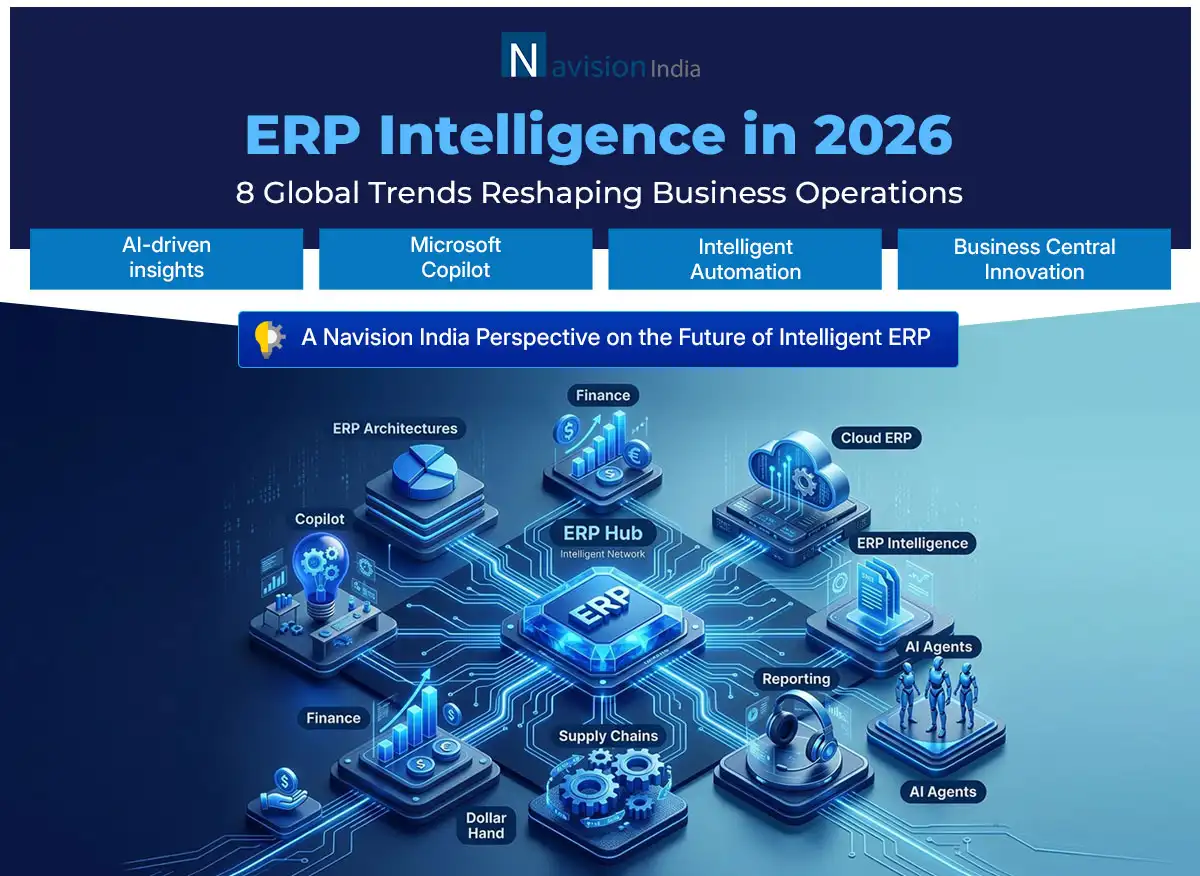
ERP Intelligence is transforming how businesses operate, make decisions, and grow in 2026. Today’s ERP systems do much more than manage transactions.
With AI, Microsoft Copilot, automation, and predictive analytics, ERP Intelligence helps organizations gain insights faster, automate routine work, and improve decision-making across finance, operations, sales, and supply chains.
Microsoft’s latest Dynamics 365 Business Central roadmap reflects this shift with continued investments in AI-powered agents, intelligent automation, and autonomous business processes.
As businesses look for greater agility and efficiency, understanding the latest ERP Intelligence trends has become essential. Here are eight global trends reshaping business operations in 2026.
This shift is being driven by artificial intelligence, AI agents, automation, predictive analytics, and deeper integration across business functions.
Microsoft has made this vision clear in its latest Dynamics 365 Business Central roadmap, with continued investments in Copilot, AI-powered agents, financial automation, supply-chain capabilities, and autonomous business processes.
At Navision India, we believe organizations should evaluate ERP strategies not just on features, but on how effectively their ERP platform can deliver intelligence, agility, and business outcomes.
Here are eight global trends that are defining the future of ERP Intelligence in 2026.
1. AI Agents Are Becoming the New Productivity Layer
One of the biggest developments in ERP Intelligence is the rise of AI agents.
Unlike traditional workflow automation, AI agents can understand context, process information, take actions, and assist users across multiple business functions.
Microsoft is expanding AI agent capabilities within Dynamics 365 Business Central to automate business processes while reducing manual effort through advanced enterprise AI solutions.
Instead of spending hours processing documents, managing approvals, or handling routine operational activities, business users can increasingly rely on AI-powered assistance.
Examples include:
- Vendor invoice processing
- Accounts payable automatio
- Document interpretation
- Workflow recommendations
- Exception management
As AI agents become more capable, ERP platforms are evolving from systems users operate into systems that actively support users.
2. ERP Intelligence Is Replacing Traditional Reporting
Historically, organizations relied on ERP reports to understand what happened.
Modern ERP Intelligence focuses on helping organizations understand:
- What is happening now
- What will happen next
- What action should be take
Industry analysts increasingly identify decision intelligence and AI-driven insights as central to the future of ERP systems. Instead of generating static reports, intelligent ERP platforms can identify anomalies, forecast trends, and recommend actions based on real-time business data.
For business leaders, the value is simple:
Faster decisions lead to faster business outcomes.
Organizations that can act on insights quickly often gain a competitive advantage over those still relying on backward-looking reports.
3. Microsoft Copilot Is Changing How Users Interact with ERP
One of the most important developments within Business Central is the continued expansion of Microsoft Copilot.
Microsoft’s vision is to make ERP more conversational, intuitive, and productivity-focused. Business users can increasingly interact with Business Central through AI-assisted experiences that simplify tasks and surface relevant information when needed.
Rather than navigating through multiple screens, users can leverage AI assistance to:
- Analyze business data
- Generate summaries
- Improve productivity
- Accelerate routine processes
- Surface operational insights
This change is particularly important for organizations seeking higher ERP adoption, as simpler user experiences often lead to greater employee engagement and productivity
4. Autonomous Finance Is Moving from Vision to Reality
Finance functions are becoming one of the largest beneficiaries of ERP Intelligence.
Organizations continue to face pressure to improve operational efficiency, reporting accuracy, regulatory compliance, and forecasting capabilities.
Modern ERP platforms are increasingly automating:
- Invoice processing
- Expense management
- Financial approvals
- Reconciliations
- Forecasting activities
Microsoft’s latest Business Central investments specifically highlight AI-driven support for payables, expenses, document interpretation, and approval processes.
The result is not the replacement of finance professionals.
Instead, finance teams can spend less time on repetitive administrative work and more time on strategic analysis and business planning.
5. Predictive Supply Chains Are Becoming a Competitive Necessity
Supply chain disruptions remain a major concern for organizations worldwide.
Businesses can no longer afford to operate with reactive planning models.
ERP Intelligence enables organizations to anticipate challenges before they impact customer service levels or profitability. Industry experts identify predictive planning and AI-driven supply chain management as major ERP priorities.
Key capabilities include:
- Demand forecasting
- Inventory optimization
- Supplier risk monitoring
- Procurement planning
- Warehouse efficiency improvements
Organizations that can predict disruptions and respond proactively are often better positioned to maintain operational resilience.
6. Cloud ERP Is Becoming the Foundation for ERP Intelligence
ERP Intelligence depends on continuous innovation.
Cloud-based ERP environments provide businesses with access to new capabilities, security updates, AI innovations, and platform improvements without the complexity associated with legacy infrastructure.
Industry forecasts continue to show growing adoption of cloud-native ERP platforms because they offer flexibility, scalability, and faster innovation cycles.
For growing businesses, cloud ERP provides:
- Rapid scalability
- Reduced infrastructure management
- Better business continuity
- Remote accessibility
- Faster deployment of innovations
This is one reason why organizations modernizing their ERP strategies increasingly prioritize cloud-first platforms such as Dynamics 365 Business Central.
7. Composable ERP Architectures Are Gaining Momentum
Business requirements evolve rapidly.
Organizations require ERP ecosystems that can evolve with them.
A growing global trend is the move toward composable ERP architecture that allow businesses to integrate specialized applications and extend functionality without replacing entire systems. Industry analysts view composable ERP as a major direction for future ERP modernization.
Benefits include:
- Greater flexibility
- Faster innovation
- Easier integration
- Reduced business disruption
- Improved scalability
This approach allows businesses to adopt emerging technologies while protecting previous ERP investments.
8. ERP Intelligence Is Driving the Shift Toward Autonomous Operations
Perhaps the most important trend of all is the movement toward autonomous business operations.
According to Microsoft’s Business Central roadmap, ERP is increasingly evolving toward AI-driven operations where intelligent systems assist with analysis, recommendations, and process execution. Microsoft’s stated direction focuses on helping organizations move from manual work toward autonomous, insight-driven operations.
The future ERP environment will not simply store information.
It will:
- Monitor transactions
- Detect risks
- Recommendation
- Automate workflows
- Continuously improve operational efficiency
Organizations that embrace this evolution will be better positioned to adapt to changing market conditions and growing business complexit
Why ERP Intelligence Matters for Growing Businesses
ERP Intelligence is no longer a concept reserved for large enterprises.
Today’s mid-sized organizations face the same challenges as global corporations:
- Rising operational costs
- Increasing customer expectations
- Supply chain uncertainty
- Workforce productivity pressures
- Growing compliance requirements
The difference is that modern platforms such as Dynamics 365 Business Central now make advanced ERP Intelligence capabilities more accessible than ever before.
Businesses that invest in intelligent ERP capabilities today will be better prepared to compete in an increasingly data-driven and AI-powered economy.
How Navision India Helps Organizations Unlock ERP Intelligence
At Navision India, we help organizations modernize operations through Microsoft Dynamics 365 Business Central, Microsoft Copilot, cloud ERP solutions, automation, and digital transformation initiatives.
Our focus extends beyond ERP implementation.
We help businesses:
- Build intelligent finance operations
- Improve operational visibility
- Automate business processes
- Automate business processes
- Leverage Microsoft AI innovations
- Scale confidently for future growth
As ERP Intelligence continues to reshape business operations, organizations need a technology partner that understands both business processes and Microsoft’s evolving ecosystem.
Conclusion
The future of ERP will not be defined by transaction processing.
It will be defined by intelligence.
AI agents, Microsoft Copilot, autonomous finance, predictive supply chains, cloud innovation, composable architectures, and data-driven decision-making are collectively shaping the next generation of business management platforms.
For organizations using—or evaluating—Dynamics 365 Business Central, the opportunity is clear: embrace ERP Intelligence today to build a more agile, efficient, and resilient business tomorrow.
The organizations that lead in 2027 will not be those with the most data. They will be the ones that use ERP Intelligence to turn data into insights, insights into decisions, and decisions into action.