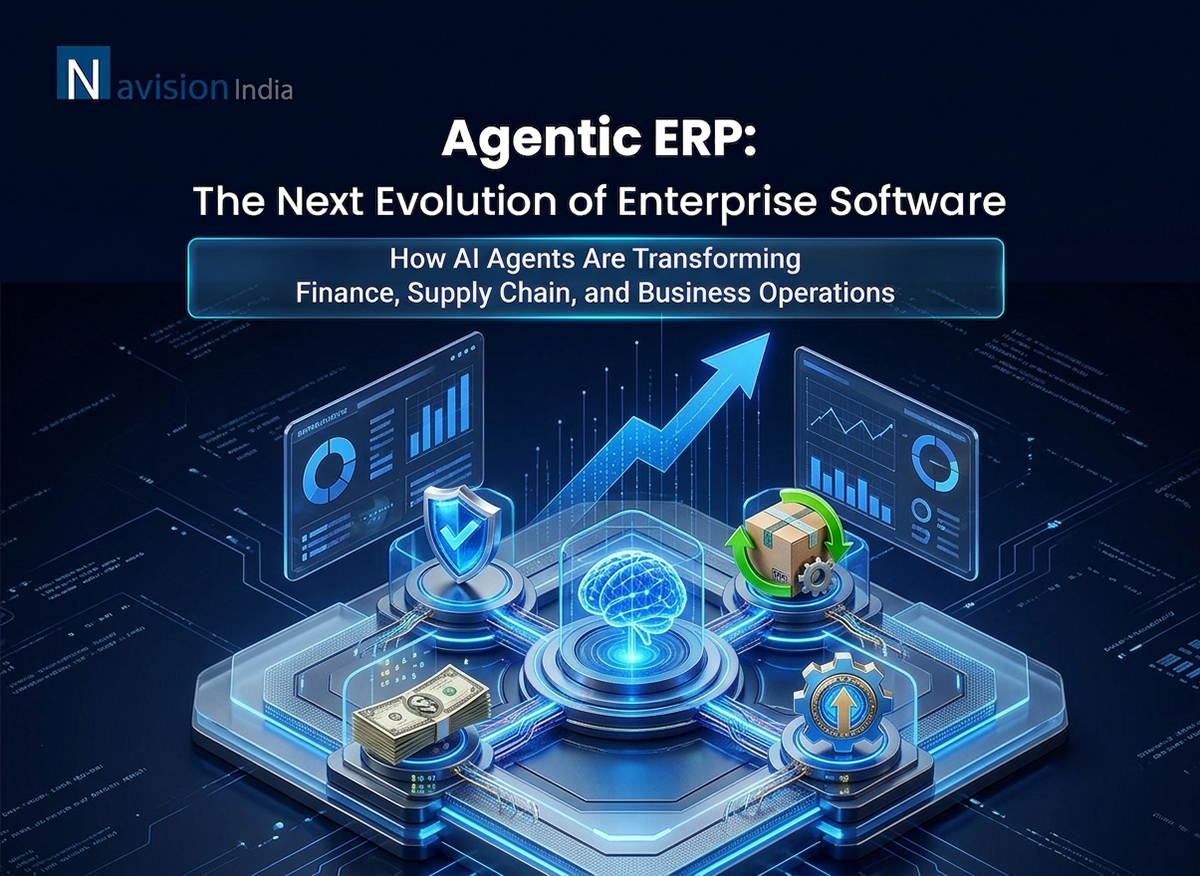
Agentic ERP is the next evolution of enterprise resource planning systems. Unlike traditional ERP platforms that primarily record transactions and generate reports, Agentic ERP uses artificial intelligence agents to analyze business data, automate actions, make recommendations, and support operational decision-making.
Traditional ERP systems tell businesses what happened.
Agentic ERP helps businesses decide what should happen next.
Powered by AI, Copilot experiences, business process agents, automation, and real-time data, Agentic ERP is transforming how finance, supply chain, sales, customer service, procurement, and operations teams work. Microsoft’s latest Dynamics 365 vision reflects this shift from systems of record to systems of action.
Why Agentic ERP Is Becoming a Business Priority
Business leaders are under increasing pressure to improve efficiency, reduce manual work, increase productivity, and make faster decisions.
Instead of waiting for employees to identify issues and take action, intelligent agents can monitor events, detect anomalies, recommend actions, and automate repetitive workflows.
How Agentic ERP Differs from Traditional ERP
Traditional ERP
Agentic ERP
Records transactions
Recommends actions
Reactive reporting
Proactive insights
Manual workflows
AI-assisted workflows
Human-driven execution
Human + AI collaboration
Static dashboards
Real-time decision support
Limited automation
Autonomous business agents
The purpose of Agentic ERP is not to replace people.
The purpose is to help teams focus on strategic work while AI agents manage repetitive operational activities.
Key Components of Agentic ERP
AI-Powered Business Agents
Business agents are specialized AI assistants embedded into operational processes.
They can:
Monitor events and transactions
Analyze operational data
Trigger business workflows
Assist users with recommendations
Perform repetitive tasks automatically
Microsoft Dynamics 365 now includes prebuilt and customizable business agents across CRM and ERP environments.
Copilot Experiences
Microsoft Copilot brings conversational AI into everyday business operations.
Instead of searching through reports or navigating multiple screens, users can ask questions and receive immediate business insights.
Examples include:
Financial reporting queries
Inventory inquiries
Supplier information requests
Sales opportunity analysis
Operational performance reviews
Business Process Automation
Agentic ERP expands automation beyond traditional workflows by introducing intelligence and decision support.
This allows organizations to automate:
Invoice processing
Account reconciliation
Order fulfillment
Lead qualification
Supplier engagement
Inventory management
Real Examples of Agentic ERP in Action
Sales Qualification Agent
An AI-powered sales agent that engages, evaluates, and prioritizes incoming leads before assigning them to sales representatives.
Business Benefits
Improved lead response time
Higher sales productivity
Better lead prioritization
Reduced administrative effort
Sales Close Agent
An AI assistant designed to analyze active opportunities and provide recommendations that help sales teams improve win rates.
Business Benefits
Faster deal progression
Better visibility into risks
Improved forecasting accuracy
More informed sales decisions
Sales Order Agent
Supports quote-to-cash processes by helping automate order creation, validation, and fulfillment.
Business Benefits
Faster order processing
Reduced manual data entry
Improved fulfillment efficiency
Better customer experience
Sales Order Agent
Microsoft is introducing AI-powered agents capable of assisting finance and operations teams with supplier communications, invoice processing, transaction matching, resource planning, and operational workflows.
Business Benefits
Reduced reconciliation effort
Improved financial accuracy
Faster processing cycles
Increased productivity
Agentic ERP in Finance
Finance departments often spend significant time performing repetitive activities.
Agentic ERP enables finance teams to focus on analysis rather than administration.
Common Finance Use Cases
Automated invoice processing
Transaction matching
Account reconciliation
Forecasting support
Budget planning
Financial reporting
Expected Outcomes
Faster month-end close
Improved reporting accuracy
Better cash-flow visibility
Reduced manual effort
Stronger financial governance
Agentic ERP in Supply Chain Management
Supply chains generate large volumes of operational data every day.
Agentic ERP helps organizations convert that data into actionable insights.
Common Supply Chain Use Cases
Supplier communication
Inventory planning
Procurement automation
Demand forecasting
Warehouse optimization
Logistics coordination
Expected Outcomes
Better inventory visibility
Reduced stock-outs
Improved supplier collaboration
Stronger forecasting accuracy
Faster operational response
Agentic ERP for Manufacturing Businesses
Manufacturers are increasingly exploring AI-driven operations to improve agility and efficiency.
Agentic ERP can help organizations:
Improve MRP accuracy
Optimize Bill of Materials (BOM) management
Reduce production bottlenecks
Improve inventory traceability
Increase capacity visibility
Strengthen production scheduling
Improve production planning
Improve shop-floor efficiency
For manufacturers, the value of Agentic ERP lies in turning operational data into proactive decisions.
Agentic ERP for Distribution Businesses
Distribution companies face constant pressure to improve fulfillment, inventory management, and demand planning.
Agentic ERP can help distributors:
Reduce stock-outs
Improve replenishment planning
Increase warehouse accuracy
Improve supplier collaboration
Support more accurate forecasting
Improve order fulfillment
Enhance inventory visibility
Reduce excess inventory
Why Many Businesses Are Not Ready for Agentic ERP
Agentic ERP relies on strong operational foundations.
Organizations often struggle because of:
Poor Master Data
Duplicate records, inaccurate inventory information, inconsistent supplier data, and reporting errors reduce AI effectiveness.
Spreadsheet-Driven Operations
When critical decisions occur outside the ERP system, AI lacks access to reliable information.
Disconnected Applications
Separate systems for finance, CRM, inventory, warehousing, procurement, and reporting create data silos.
Disconnected Applications
Separate systems for finance, CRM, inventory, warehousing, procurement, and reporting create data silos.
Inconsistent Processes
Departments operating under different workflows make automation difficult and reduce AI accuracy.
Without addressing these issues, businesses may struggle to unlock the full potential of Agentic ERP.
ERP Modernization Comes Before Agentic ERP
Successful Agentic ERP initiatives are built on strong ERP foundations.
Before implementing AI-powered agents, organizations should focus on:
Process Standardization
Establish consistent workflows across departments.
Data Governance
Improve data quality and reporting accuracy.
ERP Integration
Create a connected ecosystem across business applications.
User Adoption
Increase ERP usage and process compliance.
Cloud ERP Transformation
Modernize ERP environments to support future AI initiatives.
Organizations that modernize today will be better positioned to adopt Agentic ERP tomorrow.
How Microsoft Dynamics 365 Supports Agentic ERP
Microsoft is embedding AI-powered experiences across Dynamics 365 through:
Copilot capabilities
Business Process Agents
AI-enabled CRM applications
AI-enabled ERP applications
Finance & Operations automation
Supply chain intelligence
Customer engagement automation
This positions Dynamics 365 as a key platform supporting the evolution toward Agentic Business Applications.
How Navision India Helps Businesses Prepare for Agentic ERP
Technology alone does not create business transformation.
Organizations need the right ERP foundation, processes, data, and adoption strategy.
Navision India helps businesses prepare for the next generation of ERP through:
ERP Modernization Services
Transform legacy ERP environments into scalable cloud-based platforms.